.:[Double Click To][Close]:.

Search This Blog

Showing posts with label Mercedes-Benz. Show all posts

2010 Mercedes-Benz Sport Cars Biome Concept

2010 Mercedes-Benz Sport Cars Biome Concept
Born out of the 2010 LA Auto Show’s Los Angeles Design Challenge, in which automotive designers are given free range to envision the future of transportation, the Biome is meant to blend seamlessly into the planet’s ecosystem. That means all components of the 2010 Mercedes-Benz Sport Cars Biome Concept car are “grown” organically, and it emits pure oxygen and is fully compostable at the end of its service life.
2010 Mercedes-Benz Sport Cars Biome Concept
The basis for the Biome Concept is a vehicle that "grows in a completely organic environment from seeds sown in a nursery." Not only that, but it's powered by a combination of the sun and a chemical bond from an imaginary liquid dubbed BioNectar4534. It's all natural, all organic and all science fiction.
"As the inventor of the motor car, we wanted to illustrate the vision of the perfect vehicle of the future, which is created and functions in complete symbiosis with nature. The Mercedes-Benz BIOME is a natural technology hybrid, and forms part of our earth's ecosystem. It grows and thrives like the leaves on a tree" according to Hubert Lee, Head of the Mercedes-Benz Advanced Design Studios in Carlsbad.
2010 Mercedes-Benz Sport Cars Biome Concept
This year the competition had called for the creation of a vision of a safe and comfortable 2+2 compact car featuring good handling and a first-class design, and weighing only 1,000 lbs (around 454 kg/kerb weight).
The 2010 Mercedes-Benz Sport Cars Biome Concept symbiosis vehicle is made from an ultralight material called BioFibre and tips the scales at just 875.5 lbs (around 394 kg). This material is significantly lighter than metal or plastic, yet more robust than steel. BioFibre is grown from proprietary DNA in the Mercedes-Benz nursery, where it collects energy from the sun and stores it in a liquid chemical bond called BioNectar4534.
2010 Mercedes-Benz Sport Cars Biome Concept
The 2010 Mercedes-Benz Sport Cars Biome Concept is powered by BioNectar4534, which is stored in the BioFibre material of the chassis, interior, and wheels. In addition, Mercedes-Benz has developed a technology to equip trees with special receptors which can collect the excess solar energy and turn it into BioNectar4534. This creates a direct link with nature's energy sources and acts as an incentive to cover mobility energy requirements through more trees and at the same time maintain natural resources.
The Los Angeles Design Challenge is part of the Design Los Angeles conference, taking place from 17 to 18 November 2010 as part of the Los Angeles Auto Show.
2010 Mercedes-Benz Sport Cars Biome Concept

2010 Mercedes-Benz Sports Cars SLS AMG E-Cell Concept

After stunning Mercedes-Benz SLS AMG supercar was revealed, electric version in the future. The all-electric Mercedes-Benz AMG E-Cell SLS prototype has slightly less power than its gas-powered siblings. The E-Cell has a capacity of probably the coolest name for a painting to date – AMG Lumilectric mango.
Mercedes-AMG is accepting the challenges of motoring of the future: the SLS AMG E-CELL is evidence of the state-of-the-art development of an exciting super sports car featuring a zero-emission high-tech drive. Boasting a power output of 392 kW and 880 Nm of torque, the technology vehicle from AMG is able to offer exceptional performance.
The E-Cell features a lithium-ion polymer battery pack and electric motors which produce 392 kW (526 bhp / 533 PS) and 880 Nm (649 lb-ft) of torque. That is enough to propel the SLS AMG E-Cell from 0-62 mph in 4.0 seconds, compared to 3.8 seconds in the standard SLS.
The gullwing model accelerates from zero to 100 km/h in 4 seconds – which almost puts it on the same high level as the SLS AMG with 6.3-litre V8 engine developing 420 kW (571 hp), which can accelerate to 100 km/h in 3.8 seconds.
The SLS AMG E-CELL drive incorporates a liquid-cooled high-voltage lithium-ion battery featuring a modular design with an energy content of 48 kWh and a capacity of 40 Ah. The maximum electric load potential of the battery, which consists of 324 lithium-ion polymer cells, is 480 kW, which is an absolute best value in the automotive sector.
A revised center console has a ten-inch touch-screen infotainment system, which runs audio, climate and navigation functions. The ten-spoke wheels are staggered 19-inch front and 20 inch rear tire wearing 265/35 and 295/30. The Mercedes-Benz AMG SLS E-Cell will make his debut in a production model in 2013, a value of $ 300,000.
2010 Mercedes-Benz Sports Cars SLS AMG E-Cell Concept 
With the SLS AMG E-CELL, the performance brand of Mercedes-Benz is launching a totally innovative drive solution for super sports cars and as such is among the pioneers in this market segment.

2010 Mercedes-Benz Sports Cars SL R230 PD Series by Prior Design

PRIOR design presented their latest wide-body kit, the PD-SERIES based on the Mercedes-Benz SL R230. The Prior Design Mercedes-Benz SL R230 comes with a front spoiler with large, greedy air inlets. The cowl with its many air inlets reaches up to the windshield supplying even high-performance motors with sufficient air. 
2010 Mercedes-Benz Sports Cars SL R230 PD Series by Prior Design
For the rear side, the large track of the PD-SERIES is connected by a perfectly rounded rear bumper from one wheel arch to the other, which in turn is equipped with a diffuser based on racing technology. It is available either as sight carbon or full carbon.
The PD Series inspiration very clearly was the super sports car Mercedes-Benz SL65 AMG Black Series. The result will excite every car enthusiast : Flowing lines, massive air inlets, expressive curves and muscular sides summarize the perfect PD Series view. The side are with its wide wheels is reminiscent of a muscular monster waiting to jump its prey. The side dills harmoniously connect the masculine sides to make the car look as if made from a single cast.
The large track of the PD series is connected by a perfectly rounded rear diffuser from one wheel arch to the other, which in turn is equipped with a diffuser based on racing technology. It is available either as sight carbon or full carbon.
The 2010 Mercedes-Benz SL R230 PD Series a specially developed wheel or tyres combination is available as a complete set in the following sizes : Wheel rim PD1 (three-piece stainless steel outer bed, black finish), front axle 10×20 inch with 265/30R20, rear axle 12×20 inch with 305/25R20.

2010 Mercedes-Benz CLS Shooting Break Sports Car Concept

At the Beijing Motor Show, Mercedes-Benz just unveiled a CLS Shooting Break concept that looks to us like a frontal attack on BMW’s 5-Series GT. The moniker, which is usually spelled “shooting brake”, does not refer to the braking system but originated with custom built two-door luxury estate cars altered for use by hunters and other sportsmen such as golfers, equestrians, and polo players requiring easy access to larger storage areas than offered by the typical automobile trunk. Of course, in true German fashion Mercedes insists its spelling is in fact the correct one.
Mercedes-Benz CLS Shooting Break concept
The original way of spelling it is break, and its origin comes from back to the horse-drawn carriage days, being the name given to carriages used to “break” in wild horses and also to restrict (or “brake”) their urge to move, so that they could be put to use as work horses.
There is no doubt one of the most iconic and important introductions of the last decade has been the Mercedes-Benz CLS “four-door coupe.”
Regardless of what you decide to call it, there's little doubt that this concept leaves the stuffy ‘old world’ shooting brake neatly in the dust, replacing it with what is essentially a sneak peek of what a wagon version of the next CLS sedan could look like. 
Of course many of the oft-emulated CLS “four-door coupe” elements are there – the slippery arched profile; the swooping character line that runs seamlessly from front to rear; the long, taut body lines. But Mercedes has borrowed plenty of new elements to keep things fresh.
Those wide DTM-inspired rear fender haunches are pulled off the new E-Class sedan and coupe, and were also visible on the 2009 Concept FASCINATION that debuted in Paris. That concept also lends its wagon rear to the Shooting Brake – though curiously, no mention of that term was made two years ago. The nose incorporates the pronounced ‘classic style’ grille design of the new SLS AMG supercar, also seen in Mercedes’ F800 Style concept from the 2010 Geneva Motor Show – a car also said to give an advanced look at the next-generation CLS.
More elements from that concept also carry over, but in a more production-friendly way. The LED headlamps retain their sharp profile, but are made slightly larger; the aggressive lower front fascia is carried over nearly intact, with gaping air intakes flanking the center grille. Even the scalloped sides aft of the front wheel wells are present. Recessed door handles are said to emerge at the touch of a hand, yet sadly, the reverse-hinged rear passenger doors have been dropped from the package. Twenty-inch wheels fill out the Shooting Brake’s fender arches.
The Shooting Break concept car is driven by the forerunner to the forthcoming new V-engine generation from Mercedes-Benz. The special features of the spray-guided direct injection engine include the latest generation of piezo-electric injection valves which enable multiple injections. 
Better lean operation is possible thanks to load monitoring of the pressure information. Even the operation of the ancillary components has been made efficient and there is also a start/stop function. The V6 with a 60 cylinder angle and displacement of 3.5 litres produces 225 kW (306 hp) with a maximum torque of 370 Nm.
Unlike the F800 Style concept, there is no fuel cell or hybrid technology lurking under the Shooting Brake concept’s hood. Instead, there sits what is said to be a forerunner to the next-generation of V-configuration Mercedes engines. 
Featuring spray-guided direct-injection, piezo-electric injection valves, and start-stop technology, Mercedes says its next 60-degree-angle 3.5-liter V-6 will produce 306 horsepower with 273 pound-feet of torque.

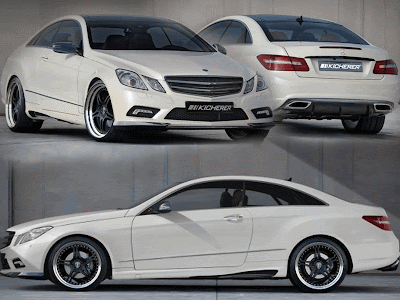
2010 Kicherer E 50 Mercedes-Benz Spots Car E-Class Coupe

The new ex-works 500 E-Class coupé is in itself not underpowered. With 388 PS and 530 Nm torque it´s the currently most powerful production model coupé that the company can offer its customers. However, those who like it a touch more dynamisc can find what they want with the traditional refiner Kicherer in Stockach. Engineers, technicans and designers have taken on the E-Class derivative and accentuated it in all things sporty, technically and optically.
2010 Kicherer E 50 Mercedes-Benz
Engineers, technicians and designers of the car refiner Kicherer in Stockach have taken on the 500 E-class coupé derivative. This new ex-works E-class is the currently most powerful production model coupé that Mercedes-Benz can offer with 388 PS and 530 Nm torque. Therefore, the Kicherer E 50 Mercedes-Benz E-Class Coupe is dedicated for customers who like the coupe with a more dynamic and sportier touch.
To give the E50 Coupé aerodynamics, Kicherer have employed the Kicherer Performance Series Package, a final polish with regards to performance and looks. This package includes a front lip, side skirts, a rear diffuser and special mirror casings. All are made of top quality and ultra-light carbon, including the three-bladed sports grill which is optionally available.
The elegant side view of the coupé is perfected by the sportily filigree Kicherer RS-1 20 inch wheels, behind which you get hints of the braking power of the 6 and 6 piston high performance brake system with composite discs and modified flexible steel tubes.
At the rear, an almost rectangular tail pipe can delight both eye and ear, since it produces an exciting but not obtrusive sound. Inside, Kicherer offered the interior elements and entry strips in epoxy resin laqueur complements the outer appearance of the E50 Coupé.
Finally, by means of software update and a sport exhaust system, the V8 performance of the E50 Coupé was increased by 42 PS and 20 Nm. As a result, the 430 hp engine can freely run to reach the speeds of up to 330 km/h.

2011 SLS AMG GT3 Mercedes-Benz - Luxurious Super Sports cars

The Mercedes-Benz SLS AMG is one of the biggest supercar releases of the past year. But the company isn't content with just making ultra luxurious supercars for the rich and well dressed, they also plan on releasing a fully homologated GT3 race version for the gentleman racer.
2011 SLS AMG GT3 Mercedes-Benz
The GT3 racing version of the SLS AMG is powered by the same mid-front mounted 6.3 litre V8 engine as the road car. There'll probably be a few modifications for the race unit, but Mercedes haven't yet announced final power outputs or specifications. Or even a final weight figure. That's all for the FIA to decide in the near future as part of the homologation process.
2011 SLS AMG GT3 Mercedes-Benz
Power transmission in the SLS AMG GT3 is done through a six-speed sequential racing transmission with steering wheel shift paddles and an integrated multi-disc locking differential. As in the SLS AMG road car, the transmission is located at the rear axle for better weight distribution: the engine and transmission are connected by a torque tube within which a carbon-fibre shaft rotates at the engine speed.
2011 SLS AMG GT3 Mercedes-Benz
The Mercedes SLS AMG GT3 is instantly recognizable as belonging to the SLS AMG family - as any GT3 racer is. The biggest visual changes are a new front apron, new splitter, redesigned bonnet with additional air intakes and vents, new sideskirts which have air inlets for cooling the rear brakes, rear diffuser and a prominent adjustable rear wing. The C-pillars provide housing for the standardized filler pipes for the fast-refuel system.
2011 SLS AMG GT3 Mercedes-Benz
The communication of Daimler release says that “the AMG V8 engine with 6.3-liter is identical to that used in the serial sports car. With a low weight, however, sports car accelerates from standstill to 100 km/h for only 3.7 seconds (serial sprint for 3.9 seconds). The maximum speed was announced for 300 mph, but producers say they have more opportunities to raise her brakes are racing by AMG, as disks are ventilated. Front wheels are size 12×18, rear 13×18.
2011 SLS AMG GT3 Mercedes-Benz
Powering this race car is a 6.3-Liter V8 engine that produces 600HP and controlling all this power is a six speed racing transmission system with shift paddles mounted on the steering wheel. The SLS AMG GT3 is designed as a racing sports car for customers competing in sprints and long-distance races.
"Thanks to uncompromising lightweight construction and superior handling dynamics, the SLS AMG provides an outstanding basis for a highly competitive racing car. This exciting GT3 version is our response to strong customer demand for a car designed for these attractive motor sports car series," says Volker Mornhinweg, Chairman of Mercedes-AMG GmbH.
2011 SLS AMG GT3 Mercedes-Benz
The body of the 2011 SLS AMG GT3 is the most significant difference from the road car starting with the aggressive front fascia and splitter to the massive rear spoiler. The hood of the race model is also very different from the normal SLS AMG with a large center cooling vent that helps to move air to cool the engine and the braking system. Along the side of the car, vents have been added to cool the rear brakes without compromising aerodynamics and all of these improvements to the overall cooling effort of the car makes it ideal for long road races like the 12 Hours of Sebring.
2011 SLS AMG GT3 Mercedes-Benz 
The SLS AMG GT3 is equipped with a six-speed racing transmission with sequential shift. A steering wheel with a diameter of 13 inches facilitates perfect vehicle control. Because it is open at the top, the driver always has a perfect view of the central display, which provides all relevant information such as road speed, engine speed, operating temperatures, lap times and gear selection. The SLS AMG GT3 is also equipped with precisely calculated cooling channels – openings in the front skirt and ahead of the rear wheels direct cool airflow over the brake discs. All four brake discs are ventilated, slotted and drilled.
The 2011 Mercedes-Benz SLS AMG race car is expected to delivery scheduled prior to the start of the 2011 racing season. However, interested customers can order this awesome vehicle starting in autumn 2010. The Mercedes-Benz display at the 2010 New York Auto Show, the 2011 SLS AMG will carry a starting price-tag of $183,000 when it goes on sale.

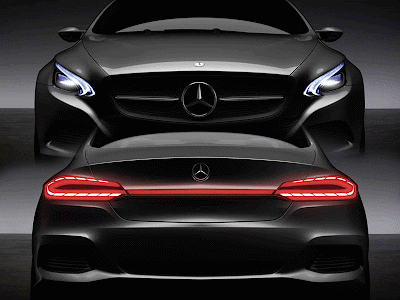
2010 Mercedes-Benz F800 Style Concept combination with the very powerful Plug-in Hybrid drive system

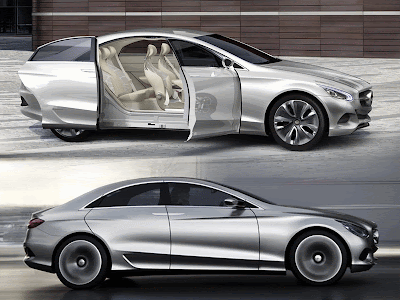
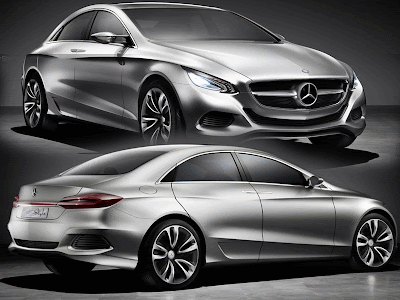
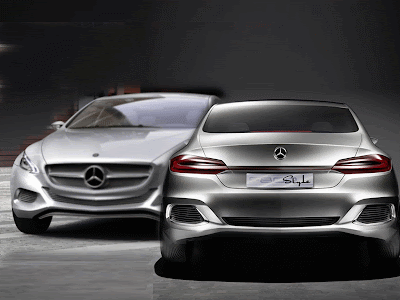
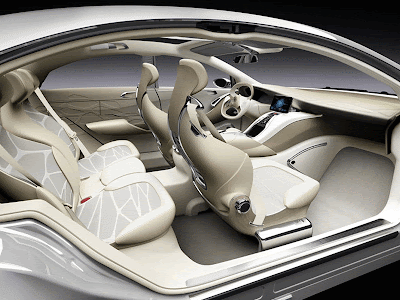
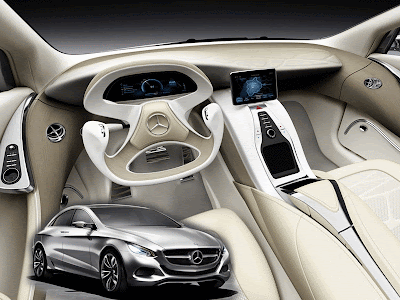
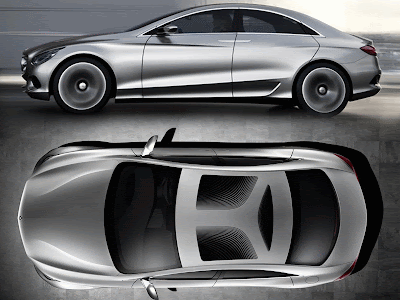
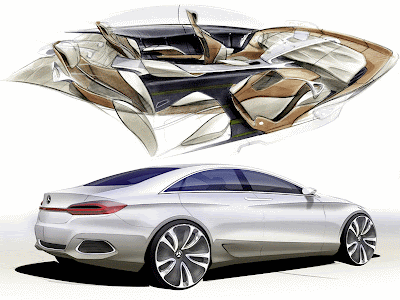
Mercedes-Benz F800 Style Concept is showing the future of premium automobiles from a new perspective, as the five-seat premium sedan combines highly efficient drive technologies with unparalleled safety and convenience features and an emotive design idiom, which interprets current Mercedes-Benz styling in line with the brand's hallmark attribute of refined performance. The F800 Style has a spacious interior full of intelligent seating, operating, and display concepts. Another unique feature of the large sedan is an all-new multi drive platform, which accommodates electric drives with fuel cells (enabling ranges of almost 375 miles) as well as the use of Plug-in Hybrids that can drive for up to 18 miles solely on electricity. Both variants of the Mercedes-Benz F800 Style Concept therefore make locally emission-free mobility possible at the level of a premium-class automobile, while at the same time being fully suited for everyday driving and providing a dynamic driving experience.
2010 Mercedes-Benz F800 Style Concept
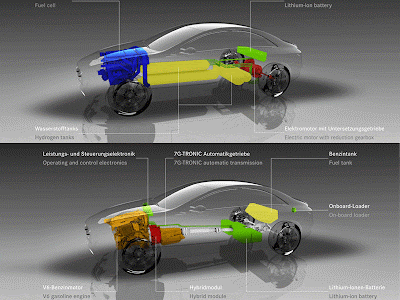
Within the 15.5-foot external length of the Mercedes F800 Style Concept, all of the components of the vehicle's efficient and environmentally compatible alternative drives (Plug-in Hybrid or fuel cell drive system) are installed in a space-saving manner in the engine compartment and the gaps within the chassis. Each of the drive systems takes up comparatively little space for the installation. This applies in particular to the electric drive with fuel cell, which has been enhanced by Mercedes-Benz to be compact and powerful. The front end's compact package was made possible through the consistent downsizing of all F-CELL components. As a result, the entire interior space is preserved and offers plenty of room for five occupants.
2010 Mercedes-Benz F800 Style Concept
In combination with the very powerful Plug-in Hybrid drive system, the Mercedes F800 Style Concept is a very dynamic expression of the concept of "fascination and responsibility." Its drive unit consists of a V6 gasoline engine with an output of 300 hp with next-generation direct injection and a hybrid module with an output 109 hp so that it delivers a total power of around 409 hp. The lithium-ion battery with a storage capacity of >10 kWh can be recharged either at a charging station or a household power socket. Thanks to its powerful and high-torque hybrid module, in the city the Mercedes-Benz F800 Style Concept can run exclusively on electricity, therefore without generating any local emissions. Because it also has high torque right from the moment it starts, the vehicle has the same driving performance as a car with a V6 gasoline engine even when operating in electric mode. The Mercedes-Benz F800 Style Concept with the Plug-in Hybrid can run purely on electricity for up to 18 miles. The F800 Style research vehicle therefore marks a further important step in the creation of a market-ready Plug-in Hybrid. Mercedes-Benz will begin series production of the S500 Plug-in Hybrid with the introduction of the next-generation S-Class.
2010 Mercedes-Benz F800 Style Concept
Due to its efficient drive system and a CO2 bonus for the battery-electric driving mode, the vehicle has a certified fuel consumption of only 2.9 liters of gasoline per 100 kilometers. This corresponds to extremely low CO2 emissions of only 68 grams per kilometer. However, thanks to its outstanding efficiency, the Mercedes-Benz F800 Style Concept equipped with a Plug-in Hybrid nevertheless has a driving performance comparable to a sports car (0-60 mph 4.7 s, top speed of 155 mph). When in electric mode, the Mercedes-Benz F800 Style Concept has a top speed of 75 mph, thus meeting the needs associated with long-distance driving.
2010 Mercedes-Benz F800 Style Concept
The electric drive components in the Mercedes-Benz F800 Style Concept with the Plug-in Hybrid once again demonstrate the versatility of Mercedes-Benz' extensively scalable modular hybrid system. The hybrid system can be expanded in various ways, depending on performance needs and the area of application. On this basis, it is possible to combine hybrid modules and batteries of different performance ratings with fuel-efficient, high-torque gasoline and diesel engines. Examples range from the current mild hybrids all the way to Plug-in Hybrids that enable pure electric driving over long distances. In developing the Mercedes-Benz F800 Style Concept with Plug-in Hybrid, the Mercedes engineers specifically focused on improving the pure electric driving in urban traffic. Thanks to high power reserves, the F800 Style in e-mode easily masters all kinds of city traffic while producing no local emissions. With the new hybrid module, the top speed of the Mercedes F800 Style Concept with Plug-in Hybrid has been increased to 75 mph in electric mode compared to the Vision S500 Plug-in Hybrid. At the same time, it emits only 68 grams of CO2 per kilometer, compared to the latter vehicle's 74 grams per kilometer.
2010 Mercedes-Benz F800 Style Concept
The F800 Style also offers clean driving pleasure in the variant equipped with an electric drive based on fuel cell technology. The vehicle's electric motor develops around 136 hp as well as a strong torque of approximately 214 lb-ft. The fuel cell generates the traction current by chemically reacting hydrogen with oxygen onboard the vehicle, producing water vapor in the process as the only emission.
2010 Mercedes-Benz F800 Style Concept
The new cam touchpad HMI is an intelligent expansion of the COMAND system. For many years now, Mercedes-Benz has been forging ahead with the development of innovative operating and display systems. A particularly user-friendly innovation is being presented in the Mercedes-Benz F800 Style Concept. The HMI unit here consists of a touchpad on the center console and a camera that records video images of the user's hand as it works the pad. The live image of the hand is presented in transparent form in the central display above the console. The user sees the contours of his or her fingers glide across the image without covering anything, thus ensuring that all of the functions of the currently used menu remain visible so that they can be easily operated by applying slight pressure to the touchpad. Pressing the display with one's fingers generates a feeling similar to that of touching laptop keys so that users know when they are carrying out specific actions.
2010 Mercedes-Benz F800 Style Concept
Another very user-friendly innovation created by the Mercedes engineers is the "Range on Map" function, which shows the remaining possible travel radius during electric vehicle operation as a 360 depiction on a map. Should municipalities only permit purely electric automobile traffic in the future, the driver can determine whether the electric range of his or her vehicle is sufficient for the journey into and out of the urban area by means of the Range on Map function. The system provides this function by combining information on the current battery charge level with data from the navigation system.
2010 Mercedes-Benz F800 Style Concept
Mercedes-Benz introduced DISTRONIC PLUS, the world's first proximity and speed control system that operates even when the car is standing still. The system substantially reduces the stress for drivers in dense traffic, as it regulates the distance from the vehicle in front even at very low speeds all the way down to a standstill. With its new DISTRONIC PLUS Traffic Jam Assistant feature in the F800 Style, Mercedes-Benz has also become the world's first automaker to implement a system that is also capable of automatically following the vehicle in front of it into curves. The system recognizes the difference between driving along curving roads and turning, which means it does not "blindly" follow the vehicle up in front — for example, when it changes lanes in order to exit the highway.
2010 Mercedes-Benz F800 Style Concept
While the Traffic Jam Assistant heightens comfort and active safety, the innovative protective system known as PRE-SAFE 360 further improves passive safety. PRE-SAFE 360 is based on the proactive occupant protection system PRE SAFE® developed by Mercedes-Benz. Unlike the previous system, PRE-SAFE 360 also monitors the area behind the vehicle. As a result, the system engages the brakes around 600 milliseconds before an anticipated rear-end collision occurs.
2010 Mercedes-Benz F800 Style Concept
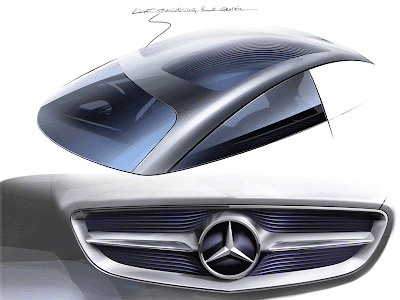
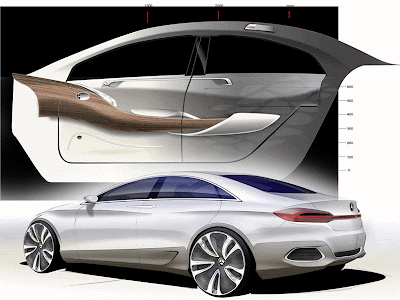
The Mercedes-Benz F800 Style Concept is both a technology platform and a showcar. This research vehicle was created through close cooperation between technical research and advanced engineering departments and the advanced design studios in Sindelfingen, Germany and Como, Italy. Its exterior appearance is marked by a long wheelbase, short body overhangs, and a sensually flowing roof line.